 Log in


 (MedPage Today) -- NEW ORLEANS -- Members of the American Diabetes Association (ADA) were escorted by police out of the convention center in New Orleans during the organization's annual meeting on Friday as they handed out copies of an editorial...
(MedPage Today) -- NEW ORLEANS -- Members of the American Diabetes Association (ADA) were escorted by police out of the convention center in New Orleans during the organization's annual meeting on Friday as they handed out copies of an editorial...
(MedPage Today) -- NEW ORLEANS -- Members of the American Diabetes Association (ADA) were escorted by police out of the convention center in New Orleans during the organization's annual meeting on Friday as they handed out copies of an editorial...



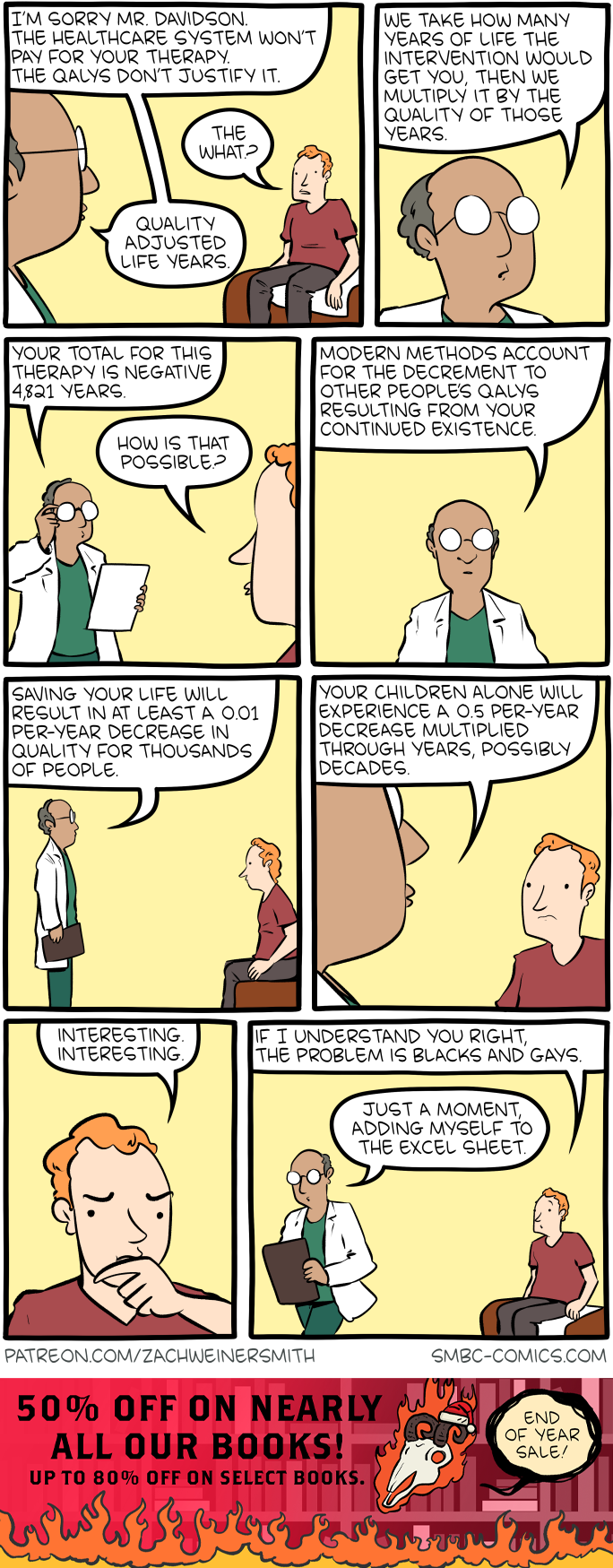
Click here to go see the bonus panel!
Hovertext:
I like to think when healthcare economists are mad they should, I'LL ADJUST THE QUALITY OF *YOUR* LIFE-YEARS!
Today's News:

In Three Guineas, an essay that expands on her writing in A Room of One’s Own, Virginia Woolf responds to a letter asking her to lend her support to the effort to prevent war. She is writing in 1937, a moment when war is less an abstract notion than an insistent neighbor, knocking loudly on the door. She considers, in light of other requests made to her, whether or not education is an antidote to war-making. But in consulting history on the matter, she is forced to conclude the opposite:
Need we collect more facts from history and biography to prove our statement that all attempt to influence the young against war through education they receive at universities must be abandoned? For do they not prove that education, the finest education in the world, does not teach people to hate force, but to use it? Do they not prove that education, far from teaching the educated generosity and magnanimity, makes them on the contrary so anxious to keep their possessions, that “grandeur and power” of which the poet speaks, in their own hands, that they will use not force but much subtler methods than force when they are asked to share them? And are not force and possessiveness very closely connected with war?
Woolf, Three Guineas, page 193
Woolf writes of the refusal on the part of most university professors to teach at the women’s colleges, of the fact that the women’s colleges are beggarly compared to those of their brothers, that women are still largely precluded from entering the universities. That is, far from the open arms one might associate with an institution committed to generosity or magnanimity, the university seems to have the qualities of a locked door. What would become of women if they acquired the key?
And the facts which we have just extracted from biography seem to prove that the professions have a certain undeniable effect upon the professors. They make the people who practice them possessive, jealous of any infringement on their rights, and highly combative if anyone dares dispute them. Are we not right then in thinking that if we enter the same professions we shall acquire the same qualities? And do not such qualities lead to war?
Woolf, Three Guineas, page 249
It is hard not to read this in light of the present-day assault on universities, of their effusive capitulation to an authoritarian power, of the huge sums of money that make paying such bribes possible—and of the wars being fought daily across our cities and streets. And, yes, on the one hand, the attack on higher education is a crime and a terrible loss, both for the students and professors, the researchers and scientists who are trampled in the process, and for humanity at large, who will no longer benefit from their great work. But so, too, is it a loss that education became so high, so much an enormous business, a place of credentials and prestige, of status and repute, grandeur and power. Anything that grows high must build up ramparts to defend itself, and where there is a wall there is—one day or another—a war.
View this post on the web, subscribe to the newsletter, or reply via email.

Almost my whole career distills down to ‘making creative tools’ of one sort or another: visualizations, maps, code, hardware. I try to live a creative life too - between music, photos, drawing, writing, and sewing I have some output. Never enough, but it’s something.
When I look back on TileMill in 2010, Mapbox Studio, Observable, the whole arc: I can’t help but worry about the supply of creativity in society. In particular:
If we give everyone the tools to build their dreams, very few people will use them.
That’s it. Only tools that are both free, easy to learn, and ideally profitable really take off and become commonplace: TikTok has a lot of ‘creators’ because the learning curve is shallow and making videos is socially and economically beneficial.
But few people want to make maps. Few people even think about the fact that anyone makes maps. The same goes for so much in society: the tools for making fonts are free and learnable, but to use them you need time and effort. Beautiful data visualizations are free to make, with lots of resources and opportunities, but the supply of people who really love and know D3 is a lot lower than I expected it would be.
I worry about this when it comes to software, too. I love home cooked apps and malleable software but I have a gnawing feeling that I’m in a bubble when I think about them. Most people’s lives are split into the things that they affect & create, and the things that already exist and they want to tune out and automate, and our lives might be tilting more toward the latter than ever before. It’s so possible to live without understanding much of the built environment or learning to build anything.
It’s not a personal issue: surely this comes downstream from a lack of free time, a cutthroat economic system, and companies that intentionally lock down their products - operating systems that only run approved software, coffee machines that only accept proprietary coffee pods.
But some of it is a personal inclination: the hesitance to share one’s art or writing or to tinker. It’s a shift of values from what you can make to what you can own. It’s a bigger cultural thing that I could ever wrap my head around, but I do think about it a lot.

In the 1880s, a French neurologist named Jean-Martin Charcot became famous for hosting theatrical public lectures in which he put young, “hysterical” women in a hypnotic trance and then narrated the symptoms of the attacks that followed. Charcot’s focus was on documenting and classifying these symptoms, but he had few theories as to their source. A group of Charcot’s followers—among them Pierre Janet, Joseph Breuer, and Sigmund Freud—would soon eagerly compete to be the first to discover the cause of this mysterious affliction.
Where Charcot showed intense interest in the expression of hysteria, he had no curiosity for women’s own testimony; he dismissed their speech as “vocalizations.” But Freud and his compatriots landed on the novel idea of talking to the women in question. What followed were years in which they talked to many women regularly, sometimes for hours a day, in what can only be termed a collaboration between themselves and their patients.
That collaboration revealed that hysteria was a condition brought about by trauma. In 1896, Freud published The Aetiology of Hysteria, asserting:
I therefore put forward the thesis that at the bottom of every case of hysteria there are one or more occurrences of premature sexual experiences, occurrences which belong to the earliest years of childhood, but which can be reproduced through the work of psycho-analysis in spite of the intervening decades. I believe that this is an important finding, the discovery of a caput Nili in neuropathology.
Herman, Trauma and Recovery, page 13
Judith Herman, in Trauma and Recovery, notes that The Aetiology remains one of the great texts on trauma; she describes Freud’s writing as rigorous and empathetic, his analysis largely in accord with present-day thinking about how sexual abuse begets trauma and post-traumatic symptoms, and with methods that effect treatment. But a curious thing happened once this paper was published: Freud began to furiously backpedal from his claims.
[Freud’s] correspondence makes clear that he was increasingly troubled by the radical social implications of his hypothesis. Hysteria was so common among women that if his patients’ stories were true, and if his theory were correct, he would be forced to conclude that what he called “perverted acts against children” were endemic, not only among the proletariat of Paris, where he had first studied hysteria, but also among the respectable bourgeois families of Vienna, where he had established his practice. This idea was simply unacceptable. It was beyond credibility.
Faced with this dilemma, Freud stopped listening to his female patients. The turning point is documented in the famous case of Dora. This, the last of Freud’s case studies on hysteria, reads more like a battle of wits than a cooperative venture. The interaction between Freud and Dora has been described as an “emotional combat.” In this case Freud still acknowledged the reality of his patient’s experience: the adolescent Dora was being used as a pawn in her father’s elaborate sex intrigues. Her father had essentially offered her to his friends as a sexual toy. Freud refused, however, to validate Dora’s feelings of outrage and humiliation. Instead, he insisted upon exploring her feelings of erotic excitement, as if the exploitative situation were a fulfillment of her desire. In an act Freud viewed as revenge, Dora broke off the treatment.
Herman, Trauma and Recovery, page 14
That is, faced with the horror of women’s experience, Freud rejected the evidence in front of him. Rather than believe the women he had collaborated with, and so be forced to revise his image of the respectable men in his midst, he chose to maintain that respectability by refusing the validity of his own observations. He would go on to develop theories of human psychology that presumed women’s inferiority and deceitfulness—in a way, projecting his own lies onto his patients.
Is this not how all supremacy thinking works? To believe that one people are less human or less intelligent or less capable is to refuse to see what’s right in front of you, over and over and over again. In order to recant his own research, Freud had to cleave his mind in two.
We must refuse to tolerate supremacists in our midst because their beliefs do real and lasting harm, because their speech gives rise to terrible violence. But we must also refuse them because they are compromised. They cannot trust their own minds. And so cannot be trusted in turn.
View this post on the web, subscribe to the newsletter, or reply via email.


Two incidents took place this week, which didn’t initially seem to have much to do with each other. In one, Labour leader Keir Starmer called Nigel Farage’s mass deportation policy racist. In another, the American writer Ta-Nehisi Coates challenged commentator Ezra Klein on whether it was right of him to praise the far-right campaigner Charles Kirk after he died.
On the face of it, they seemed like very distant events. Starmer’s speech took place at the height of British politics. Klein’s interview took place in a US podcast studio. But in fact they centred on precisely the same question: What’s the shit you won’t put up with? Where do you draw the moral line in an era of prejudice and authoritarianism? And what happens when you do so?
We all think we have an easy answer to that question. We don’t. It’s much tougher than we expect. No-one has a decent response. Those that do are either impotent or cynical.
This is about one of the most challenging and least understood questions in politics: when you should compromise and when you shouldn’t.
Halfway through the Coates interview, Klein said something very interesting. He revealed a fundamental element of his political personality.
“The president of the United States is a person who, in his comportment as a human being on the public stage, I would have said in 2008, 2012, in 2016, should be on the other side of the line,” he said. “I think he’s a person who does not act with any sense of public, or even personal, decency. And then he won in ’16, lost sort of narrowly in ’20 and then won in 2024. And the thing that this has led to, for me, is recognising that I don’t get to draw the line. Now it doesn’t mean I don’t have one in my own heart. But the thing that I am struggling with is that for most people, or a lot of people, the plurality of the voters in the last election: He is somehow not way over the line. That means there are a lot of people who are willing to accept things that I thought we would have found unacceptable.”
A similar sentiment was expressed after Starmer’s conference speech, in which he used strong moral terms against Farage for the first time. Several MPs anonymously whispered to journalists that it wasn’t wise to do so, because Reform voters will think they’re being called racist. A Times commentator debating me on BBC Scotland said that he would have thought Farage’s policy was racist years ago, but now the public mood has changed, so it isn’t.
In the Statesman, data journalist Ben Walker wrote: “Starmer has made contentious debate more contentious and has told the median Briton they are wrong. The median Briton would be seeing not an attack on policy, but an attack on the sentiment. And on the sentiment, the median Briton would feel they’re part of that. They’re being labelled racist too.”
The Klein interview and the Walker piece comes from the same place: No matter what we might think of these things, the median voter is comfortable with them. It is therefore wrong to say that they are racist or immoral. And even if it is not wrong, it is unhelpful - it alienates those whose support you need to attract.
It’s not clear that Walker’s argument holds on the basis of the evidence he presents. He focuses on whether Farage is racist rather than the policy itself - a different issue. And even then, the data he uses suggests the median voter isn’t actually sure if Farage is racist and is therefore persuadable. He understates the median voter’s wariness of Reform’s extremism. He stresses “immigration vibes favour Reform more than they do Labour”, but does not make any effort to look into public feeling about individual policies - like a mass deportation programme - where Labour clearly feels it can win the argument. It’s a very weak piece.
But the main problem with the Klein/Walker position is not empirical, it is about practical consequence. It assumes that the public have no moral sense at all, or at least one so far removed from basic progressive values as to be non-existent for our purposes. And then it dictates that we keep our mouths shut about egregious assaults on immigrants so that we stay on the right side of public opinion.
Walker says: “There’s a time and a place for calling a policy or a party or a politician racist. That time was not now.” This is a very popular view in political circles. It sounds composed and respectable. You must be terribly careful with this word, old chap. Don’t use it too quickly or it’ll lose its power. Don’t use it unwisely or it’ll backfire, and you won’t be able to deploy it when it matters. It’s an easy default position to adopt because it seems unflustered, the product of a mind which is insulated against leftie hysteria.
Although the view sounds like a dismissal of political activism, it is in fact a form of activism in itself. It seeks and achieves political outcomes. Earlier this year Tory MP James Cleverly attacked Starmer for using the words ‘far-right’ when discussing a far-right media campaign led by Elon Musk. “Accusing those who disagree with him, or who seek legitimate answers about repeated failures of child protection, as ‘far-right’ is deeply insulting and counterproductive,” he wrote on X. The Mail tried the same tactic this week with its headline: “Worried about immigration? Starmer says you’re racist.”
A great deal of British political commentary takes place in this liminal zone between polling, strategy and morality. Data journalists write pieces about the public view, right-wing politicians and editors then use it to defend themselves against attack.
The primary effect of this sort of coverage is the death of objective reality. We get lost in a debate which is exclusively about what voters think about things. It completely ignores the core issue: Is the policy racist? Is it far-right? The idea that there is a real external world and that words mean something fades away. It is replaced by the shifting sands of public sentiment.
Without an objective moral standard, there is no depth to which we will not sink. Perhaps slavery is OK. Perhaps wives legally belong to their husband. Perhaps we should initiate a new era of colonialism. That sounds excessive, of course. But mass deportations would have been an unthinkable policy just five years ago. Now they’re discussed on morning television. The consequence of only discussing popularity and not morality is that there is no protection against deeply immoral ideas.
The secondary effect is to discourage centre-left figures from being able to speak honestly and confidently about their values. Once you stop holding to a moral line, you are part of the oppressor’s project. You are the handmaiden of the far-right. You give up on resistance. You not only stop fighting back yourself, but you actively discourage others from doing so.
You can see this very clearly over the first year of the Trump administration - people failing to resist, in newsrooms and courtrooms and boardrooms. People taking decisions which aid Trump without him even having to press for them. They do it by giving up on their values and refusing to fight for them. It is surrender. They hand him piecemeal what he would otherwise have taken at once.
There is something particularly egregious when you see people with very large followings - Klein is successful and widely read - giving up on maintaining moral norms. His sense of powerlessness is frustrating precisely because he does have considerable influence and yet refuses to use it. He is despairing at a world that is partly of his own making.
It should therefore be entirely obvious which side I am on in this debate. I am sick and tired of watching people with decent, compassionate values constantly be told to accommodate the views of people who lack decency or compassion. I am exhausted by a world which seems like a macabre inversion of elementary moral principles. I want the kind to be strong and the cruel to be weak and I am sick of seeing things operate in the opposite direction.
But honestly, I feel considerable sympathy with Klein. You can hear in someone’s voice when their bones are scraping against their soul, when they’ve been hollowed out by events, when their view of humanity is being shattered on an electoral shore. He is searching for answers, which is more than most people do in similar circumstances, when they retreat back into their ideological shell.
Practical, pragmatic people often sound like they’re a moral vacuum. But in fact they are following a different kind of morality. Instead of trying to uphold moral norms, they are trying to secure moral outcomes, particularly by winning elections.
At one point, Klein and Coates discussed the way the Trump administration is poisoning the US against trans people. Klein then says something which is profoundly moral. “I think that in losing as badly as we have, we have imperiled trans people terribly.”
That’s correct. You can defend minorities as much as you like, but if your refusal to compromise makes you electorally irrelevant then you have not helped them. You have sacrificed them to your own sense of virtue. Compromise is not self-interested. It is the mechanism by which you win. When liberals and progressives forget how to win, they fail to help the people who need them.
Take Jeremy Corbyn. When it comes to refugees, I share his values. But what good has he ever done them? He has marched for them. He has spoken out for them. He has held a thousand microphones on a thousand marches and expressed a thousand words of solidarity. And I’ve no doubt that he’s done decent constituency work to assist them as individuals. But in terms of policy, he has never done anything at all to help them because he never had power.
The reason he never had power - and never will - is because he is unable to compromise. He is unable to find the space between his own values and the disposition of the British people. Those who loved him found something reassuring and principled in this. I thought he looked dead inside, a jumble of response-mechanisms without an internal intelligence to control them.
Take Margaret Thatcher. Early Thatcher was actually a pragmatic figure. She served as a One Nation education secretary. Even as prime minister she was initially cautious on policy. She never privatised rail, or the NHS, or the BBC. It was only in her later years that she became immoveable and dogmatic.
Her admirers have somehow contrived to make this the most cherished version of her. But in actual fact, it was the point that she basically went mad - unable to countenance criticism, unable to even comprehend it, so adrift from public opinion and any sense of natural justice that she made repeated catastrophic errors. It was the precise moment at which she stopped winning and started losing.
This debate is basically about whether you follow the politics of values or the politics of strategy.
It’s incredibly revealing to me that it maps directly onto the core dispute in moral philosophy: Does an action become moral because of its consequences or on the basis of principles?
On one side of that debate are consequentialists - people like Jeremy Bentham. They believe an action is moral because of the effect. If a train is out of control and going to hit one of two platforms, you should morally pull the lever and send it crashing into the platform where there are fewer people.
On the other side of that debate are the deontologists - people like Immanuel Kant. They believe an action is moral because it is based on basic rules. They think, for instance, that you can never morally torture someone, even if it secures vital information that stops a terrorist attack, because torture is wrong.
It’s telling that both of these views were founded by deeply weird and broken men. Both of them drive their adherents insane. A strict consequentialist, for instance, would argue that if your mother and a man who might cure cancer are on a sinking boat, you should save the man first. A strict deontologist would argue that if you were hiding Anne Frank and a Nazi asked where she was, you’d have to tell him, because it’s wrong to lie. No sensible person can abide by either of these systems.
Similarly, no sensible person submits fully to the politics of values or the politics of strategy. They would be either utterly dogmatic and irrelevant, or utterly cynical and empty. You wouldn’t want to know them, you wouldn’t want to read them, and you wouldn’t want to be governed by them.
Almost all of us are somewhere in the middle. We all believe in compromise. We all think you have to forsake some of your convictions in order to build alliances, or win over wavering voters, or get a piece of legislation through, or even just get on with your family at the dinner table. But we all also have things with which we simply will not fucking put. We have values we are unwilling to forsake, no matter what happens, no matter how unpopular they become, no matter what the consequences are of our obstinacy.
None of us are really on one side or other of this debate. Instead, we have dispositions, instincts, and even moods. At certain times, in certain contexts, we are more open to compromise. In other times, in different contexts, we are not.
Is there a solution? No, of course not, we’re human and all messed up. But we can commit to thinking clearly about it. We can articulate which values we can compromise on and which we can’t. We can describe the outcomes which are tolerable and those which are not.
Most importantly, we can search for ways to combine the pragmatism of strategic politics with the force of values politics. That means being evidence led - looking for weaknesses in the populist argument, searching for where they’ve gone over a line and contradicted the public’s sense of natural justice, then zeroing in on that remorselessly. It means demanding a communications strategy which isolates these areas where their politics of division is most vulnerable.
Right now, for instance, several mainstream right-wing commentators are claiming that black people cannot be English. Matthew Goodwin has said it. Isabel Oakshott has said it. This is absolute poison, obviously, but it is also contrary to public opinion. It is unpopular. I would like to see a Labour communication strategy which punches that bruise. Make it the chief issue, focus remorselessly on it. Force everyone on the right to either disassociate themselves from it or be branded a racist for holding it.
This would serve an electoral function which appeals to advocates of strategic politics. It would splinter the right-wing populist alliance and create volatile internal disputes. It would get Labour on the front foot, defining the conversation, and force Farage onto the backfoot. This week alone has demonstrated how much less sure-footed he is when he is unable to set the agenda.
It would also serve a moral function which appeals to advocates of values politics. It would shore up anti-racist norms. It would beam out a message across society that this is a thing you should not say and should not think, or you’ll risk social isolation. In a period of progressive defeat, it would firm up a wall behind us.
The heart cannot function without the head and the head is useless without the heart. The binary is bullshit. There are no answers to be found from those who demand that we only pursue strategy, or only pursue values. Instead, we must think clearly about where one or the other is appropriate. And then look closely for where we can synthesise them.
Odds and sods
Really sorry there’s no audio this week. The recording equipment thing went horribly wrong. Normal service will resume next week when I’ve figured out how to do it. If anyone has recommendations for audio recording software/sites that work on a cheap as fuck Chromebook, hit me up.
Couple of pieces in the i paper this week. The first was on Starmer’s conference speech. I honestly expected to be more critical than I was and was extremely pleased to find myself writing something supportive. The second was on Labour’s growing confidence criticising Brexit and how this reveals that a consensus has really been reached. Quietly, without much drama and no single moment of realisation, the country has decided that it was a shit idea. Better late than never, I guess.
The first episode of our Origin Story two-parter on Marx came out on Wednesday. It’s a mad tale of stroppy philosophers engaging in pointless bad-tempered drive-by shootings on obscure German colleagues while occasionally pausing to sketch out some ideas that change the world. If you’ve ever wondered about Marx or wished you understood it without having to do all the reading, that’s basically what we’re here for. We will painlessly explain everything you need to know about his philosophy, independently and fairly, while making sure that it’s always an entertaining listen full of laughs and drama.
Our core editorial principle is that intelligent people want to learn about the world, but that it should be entertaining to do so. This is a case in point. Check out the clip below. If you like that, you’ll like the show. You can find it on Apple, Spotify or wherever you get your podcasts.
I love the podcast Search Engine. It’s funny and curious and searching and detailed. The idea is that the host tries to answer a question by talking to experts. The questions are usually fairly harmless but very revealing about the world around you.
This week, I did something odd, and went back to listen to one of my favourite old episodes. I’m not sure I’ve ever done that - treated a podcast like a favourite movie or TV episode. It’s an interview with Ben Brode, the designer behind the mobile game Marvel Snap.
That game, man. I was playing it once when my partner left for the night. Ten minutes she returned and I realised that I was sitting in the dark staring at my screen and four hours had passed. I deleted it the next day.
What starts as a conversation about mobile video games quickly becomes something else. It is about the mechanics of games in general and in particular about how a really strong game design includes chance and skills but does not treat them as opposites. It’s also about how we really improve at the things we’re good at and how play unites us as a species. Also, there’s a bit about professional rock-paper-scissors tournaments, which apparently involve one minute of trying to psychologically fuck up your opponent before you play. I think I may actually have to go to one of those, it sounds amazing. You can listen here. Strong recommend.
Right, that’s your lot. Fuck off you cunts.

Next Page of Stories